


A2Z Drone Delivery has launched the Longtail Dual, a new multi-mission commercial UAV designed around battery redundancy, automated charging and increasingly complex beyond-visual-line-of-sight (BVLOS) operations. Announced on August 31, 2026, the Longtail Dual builds on A2Z's existing Longtail platform while introducing a dual-battery architecture intended to keep the aircraft fully controllable if one battery experiences a failure.
The launch is significant because A2Z is targeting a part of the commercial drone market where reliability and operational continuity can be just as important as payload capacity. The company is positioning the Longtail Dual for delivery, patrol, Drone as First Responder (DFR), emergency response, maritime and other multi-mission applications.
The new aircraft is also designed to operate as part of the company's broader A2Z AirDock ecosystem. Rather than treating the drone as an isolated aircraft, A2Z combines the Longtail Dual with automated docking, charging, mission management and remote fleet operations to create a persistent commercial drone network.
That approach places the Longtail Dual directly within several of the most important developments covered by Drone Industry Report September 2026 | AI, BVLOS & Trends: BVLOS operations, autonomous infrastructure, remote supervision, delivery drones and increasingly resilient commercial UAV systems.
MidronePro Take: The most important part of the A2Z Longtail Dual launch is not simply the addition of a second battery. It is the move toward treating power redundancy, automated charging, remote fleet management and mission payloads as parts of one commercial UAV architecture.
For BVLOS operations over populated areas, battery failure is an operational risk rather than merely a maintenance problem. A2Z's approach attempts to address that failure mode at the aircraft level while simultaneously reducing downtime through AirDock charging. The result is a platform designed around continuous commercial operations rather than individual drone flights.

Official A2Z Drone Delivery imagery.
A2Z Launches the Longtail Dual
A2Z Drone Delivery announced the Longtail Dual on August 31, 2026, describing it as the company's latest multi-mission commercial drone.
The aircraft retains the basic Longtail platform's propulsion systems and avionics while adding a dual-battery architecture, smart battery monitoring and faster charging within the A2Z AirDock ecosystem.
A2Z says the new design is intended to address the operational requirements associated with long-range BVLOS missions, particularly flights over urban environments and people.
The company also positions the aircraft as a platform that can support both delivery and patrol operations rather than requiring separate aircraft architectures for every mission type.
That distinction is important. Commercial drone deployment increasingly involves networks of aircraft, docking stations, payload systems and remote operators rather than isolated point-to-point flights.
What Is the A2Z Longtail Dual?
The Longtail Dual is a commercial hexacopter UAV designed for autonomous and remotely supervised missions.
Its defining feature is the use of two independent batteries. A2Z states that the aircraft maintains full flight control and operation on a single battery if the other battery fails.
The company describes this as true battery redundancy rather than simply carrying additional battery capacity.
That distinction matters for BVLOS operations. If an aircraft is operating beyond the pilot's visual line of sight, a power-system failure can create a substantially different operational risk than it would during a short-range recreational flight.
The Longtail Dual therefore addresses battery reliability as part of the aircraft's safety architecture.
A2Z Longtail Dual Key Specifications
| Specification | Longtail Dual |
|---|---|
| Aircraft configuration | Hexacopter |
| Battery configuration | Dual battery |
| Battery redundancy | Yes |
| Dual-battery Cargo payload | Up to 5.84 lb / 2.65 kg |
| Dual-battery Cargo range | Up to 9.3 mi / 15 km |
| Dual-battery Patrol range | Up to 11.8 mi / 19 km |
| Dual-battery Cargo aircraft weight | 29.98 lb / 13.6 kg |
| Dual-battery Patrol aircraft weight | 31.25 lb / 14.17 kg |
| Cargo winch capacity | Up to 11 lb / 5 kg |
| Weather rating | IPX4 |
| AirDock compatibility | Yes |
A2Z's current Longtail documentation distinguishes the payload and range figures between single- and dual-battery configurations. The dual-battery Cargo configuration is listed at up to 2.65 kg payload and 15 km range, while the dual-battery Patrol configuration is listed at up to 19 km range. ([A2Z Drone Delivery](https://www.a2zdronedelivery.com/longtail-delivery-drone))
Why Dual-Battery Redundancy Matters
The central engineering change is straightforward: the Longtail Dual carries two batteries that are designed to provide operational redundancy.
A2Z states that the aircraft can maintain full control and operation on one battery if the other experiences a failure.
This is fundamentally different from simply increasing total energy capacity.
In a conventional single-battery configuration, a critical battery failure can potentially become an aircraft-level emergency. With a redundant architecture, the aircraft has another power source available to continue the mission or execute an appropriate recovery procedure.
That capability is particularly relevant to BVLOS operations over populated environments, where operators and regulators have to consider what happens when individual aircraft components fail.
A2Z says the dual-battery design was specifically developed to help mitigate this risk.
Smart Battery Monitoring and Charging
The Longtail Dual's battery system is not limited to redundancy.
A2Z says its smart battery architecture monitors:
- Battery cell temperature
- Battery cycle count
- Cell balance
- Battery health and degradation
The aircraft also carries over the Longtail's battery-heating system for cold-weather operations.
An automated standby mode is designed to minimize power consumption while the aircraft is waiting for its next mission on an AirDock.
This becomes particularly important when the drone is treated as part of a network rather than as an aircraft that is manually prepared for every individual flight.
Hexacopter Redundancy and Aircraft Safety
Battery redundancy is only one layer of the Longtail Dual's safety architecture.
The aircraft uses a hexacopter configuration, giving it six propulsion units. A2Z states that the aircraft can continue safe operation despite a single propulsion failure.
The company also incorporates real-time motor feedback through CAN-bus motor systems, allowing motor performance and service cycles to be monitored.
Other listed safety features include an onboard strobe light, optional parachute and optional ADS-B In capability.
The overall design therefore addresses multiple failure and situational-awareness scenarios rather than treating the second battery as a standalone feature.
Redundant Communications and Situational Awareness
Long-range commercial UAV operations depend on more than the aircraft's propulsion system.
A2Z says the Longtail Dual includes dual-redundant cellular connectivity, allowing the aircraft to automatically switch between cellular providers for video and telemetry during long-range missions.
The broader Longtail platform also supports multi-link communications including cellular and radio systems.
This architecture is important because commercial BVLOS operations require reliable command, control and telemetry links. The aircraft needs to remain connected to its operators and operational infrastructure while travelling beyond direct visual observation.
The optional ADS-B In module provides another layer of situational awareness by allowing the aircraft to receive positioning information from nearby traffic equipped to broadcast relevant data.
These systems should not be confused with regulatory approval by themselves. Hardware capability does not automatically authorize BVLOS operation.
Longtail Dual Cargo

The Longtail Dual Cargo configuration is aimed at delivery and logistics operations.
Its factory-integrated payload includes the A2Z RDS2 commercial drone winch, a downward-facing LiDAR sensor and dual FPV cameras.
The RDS2 winch can carry up to 11 lb / 5 kg according to A2Z. However, when the optional parachute is installed, the company lists a maximum payload of 5.84 lb / 2.65 kg while remaining within the common 55-pound maximum takeoff weight referenced in its launch material.
The winch allows packages or other payloads to be lowered from altitude rather than requiring the aircraft to land at the delivery location.
That operating concept has a practical safety advantage: the aircraft's spinning rotors can remain away from people and ground-level obstacles during delivery.
LiDAR-Assisted Delivery
The downward-facing LiDAR sensor is integrated with the winch system to support more precise delivery positioning.
That becomes especially useful when the aircraft needs to place or retrieve a payload without landing.
Potential Delivery Applications
- Retail deliveries
- Food logistics
- Medical supplies
- Tools and equipment
- Sample retrieval
- Inter-site transport
- Shore-to-ship logistics
Longtail Dual Patrol

The second major configuration is the Longtail Dual Patrol.
Rather than prioritizing cargo delivery, Patrol is designed for survey, surveillance, public safety and DFR missions.
A2Z lists a quad-sensor gimbal incorporating:
- 48 MP 11× optical-zoom RGB camera
- 48 MP wide-angle camera
- 1,200 m laser rangefinder
- 640 × 512 thermal sensor
The payload is complemented by a high-power LED spotlight, a high-power megaphone and an optional commercial drone winch.
This creates a substantially different mission profile from Cargo. Instead of transporting goods, the aircraft becomes a mobile sensing and response platform.
Drone as First Responder
DFR programs use drones to provide aerial awareness to emergency-response teams. A patrol-configured Longtail Dual could provide remote video, thermal imagery, lighting and communication capabilities before or during the arrival of ground personnel.
The ability to operate remotely and dock automatically is particularly relevant to this model because the aircraft can remain positioned within a network rather than requiring a crew to physically transport and launch it for every mission.
The A2Z AirDock Ecosystem
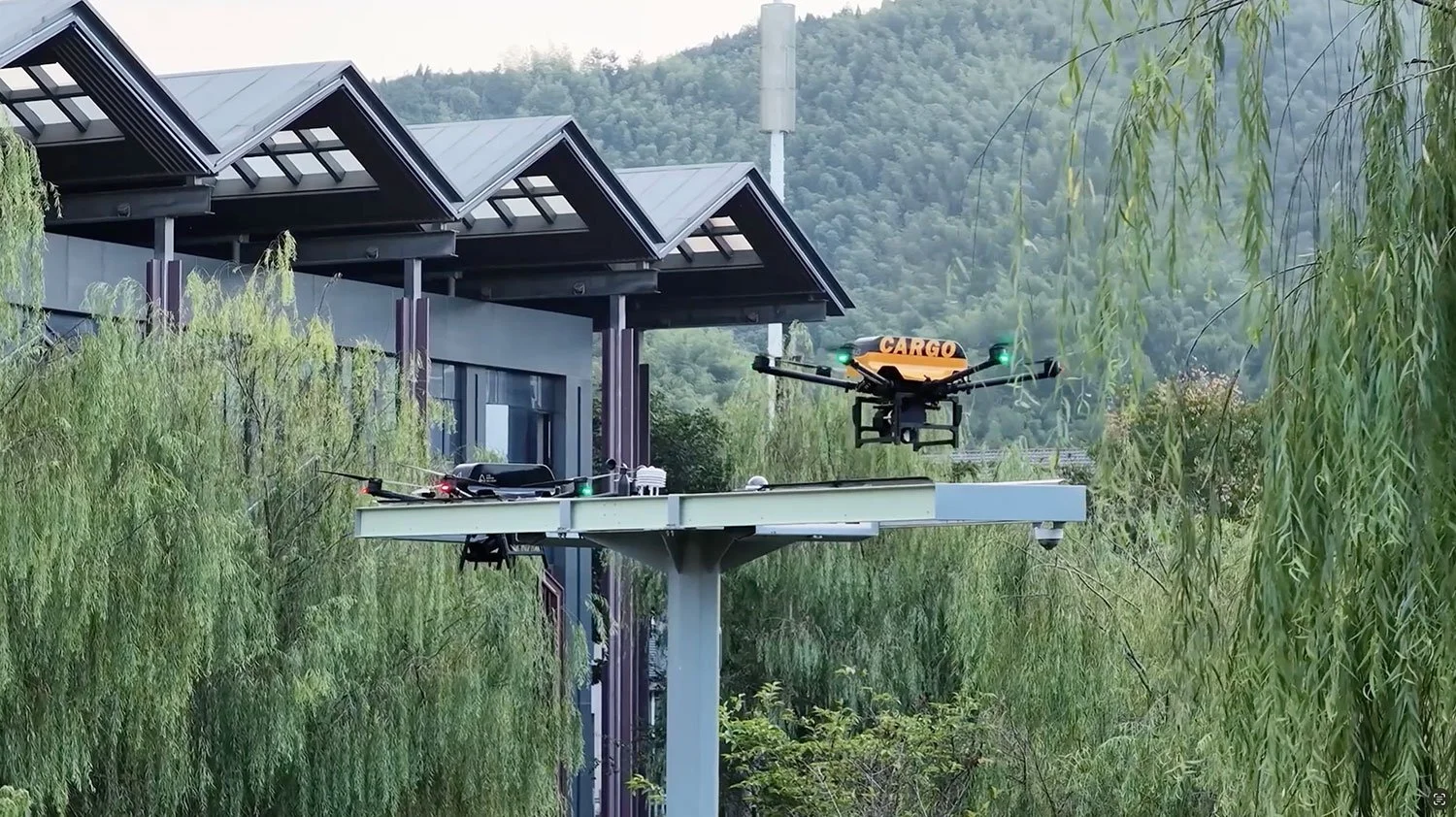
The Longtail Dual becomes considerably more interesting when viewed together with the A2Z AirDock.
The AirDock is an automated docking and charging station designed specifically around A2Z's aircraft ecosystem.
Instead of returning to a conventional ground station where personnel manually remove batteries and prepare the aircraft, the Longtail can return to an AirDock, perch, recharge and prepare for another mission.
A2Z states that the Longtail Dual's battery architecture enables a flight-to-charge ratio of up to approximately one-to-one when using its AirDock infrastructure.
That means a one-hour flight can be followed by approximately one hour of charging under the company's specified operating concept.
The significance is operational rather than merely numerical: reducing charging downtime can increase the number of missions an individual aircraft can perform over a given period.
CloudOS and Remote Fleet Operations
The AirDock network is paired with A2Z's CloudOS flight-operations software.
The platform is designed to allow operators to:
- Plan missions remotely
- Create repeatable routes
- Monitor aircraft status
- Track battery condition
- View live mission information
- Monitor fleet availability
- Review mission history
- Support predictive maintenance
This moves the Longtail Dual beyond the traditional concept of a drone controlled by one pilot.
Instead, the operational architecture becomes:
Aircraft → AirDock → Communications → CloudOS → Remote Operations Center
That architecture is closely related to the wider development of Autonomous Drones, AI, BVLOS and Drone-in-a-Box Guide.
Beyond Package Delivery
Despite its company name, A2Z is positioning the Longtail Dual as a broader commercial UAV platform rather than a drone designed exclusively for parcel delivery.
The current platform supports applications including:
- Medical logistics
- Last-mile delivery
- Maritime operations
- Inter-site transport
- Infrastructure inspection
- Search and rescue
- Public safety
- Drone as First Responder
- Survey and surveillance
This multi-mission approach is significant because drone infrastructure is expensive to deploy. If one aircraft and docking network can support several services, the infrastructure can potentially be utilized more frequently.
A2Z explicitly describes AirDock networks as shareable between multiple stakeholders and mission types.
BVLOS and Regulatory Considerations
The Longtail Dual is designed specifically around commercial BVLOS operations, but it is important to distinguish engineering readiness from regulatory authorization.
A2Z says the Longtail Dual was developed to help customers navigate regulatory pathways including FAA Part 107 waivers, Part 135 operator certification pathways and European SORA frameworks.
That does not mean that simply purchasing the aircraft grants an operator permission to conduct BVLOS flights.
Operators still have to satisfy the requirements applicable to their jurisdiction, operating category, aircraft configuration, mission and airspace.
This distinction becomes increasingly important as autonomous delivery and DFR operations move into populated environments.
For a deeper technical explanation of BVLOS operations, see BVLOS Drones in 2026: Complete Guide to Beyond Visual Line of Sight Operations.
European operators can also explore SORA 2.5 Explained: The Complete Guide to EU Drone Risk Assessment in 2026 for the risk-assessment framework relevant to more complex UAS operations.
Longtail Single Battery vs Dual Battery
| Characteristic | Single Battery | Dual Battery |
|---|---|---|
| Battery count | 1 | 2 |
| Battery redundancy | No | Yes |
| Cargo maximum payload | Up to 11 lb / 5 kg | Up to 5.84 lb / 2.65 kg |
| Cargo range | Up to 11.18 mi / 18 km | Up to 9.3 mi / 15 km |
| Primary priority | Maximum payload | Power redundancy |
The choice is therefore mission-dependent.
A logistics operator carrying heavier payloads may prioritize maximum payload capacity, while a public-safety or critical-delivery operator may place greater value on redundant power.
A2Z's own positioning is that the dual-battery architecture involves a payload trade-off in exchange for additional operational resilience.
Why the Longtail Dual Matters for the Drone Industry
1. Battery Redundancy Is Becoming a Commercial Requirement
As drones move into more complex BVLOS environments, redundancy becomes increasingly important. The Longtail Dual demonstrates how battery architecture can become part of the aircraft's operational safety case rather than simply a flight-time consideration.
2. Drone Delivery Is Becoming Infrastructure
The Longtail Dual is designed around AirDock infrastructure. That means the aircraft is one component in a larger network of docks, software, payload systems and communications.
3. One Aircraft Can Support Multiple Services
The Cargo and Patrol configurations demonstrate how a common aircraft platform can be adapted for logistics, public safety, surveillance and emergency response.
4. Automated Charging Changes Fleet Economics
The one-to-one flight-to-charge concept is designed to reduce downtime. When multiplied across a network, charging efficiency can become an important factor in the economics of commercial drone operations.
5. BVLOS Is Driving System-Level Design
Longtail Dual's redundant batteries, communications, motor monitoring, optional ADS-B and parachute options all reflect the increasing complexity of commercial BVLOS missions.
These developments connect closely with Detect and Avoid Technology for BVLOS: Complete 2026 Guide, where the broader aircraft and airspace-safety technologies required for increasingly complex BVLOS operations are examined.
What the Launch Does Not Establish
The Longtail Dual launch provides a detailed picture of the aircraft's design, but several questions remain dependent on individual deployment and regulatory conditions.
For example, the published range figures vary according to battery configuration and payload. They should therefore not be interpreted as universal mission-radius figures.
Similarly, the presence of redundant batteries, cellular communications and optional ADS-B does not itself establish regulatory authorization for any particular BVLOS operation.
Real-world delivery economics will also depend on factors beyond aircraft specifications, including AirDock deployment costs, communications availability, local regulations, payload demand, maintenance requirements and fleet utilization.
The same applies to the one-to-one flight-to-charge figure. A2Z presents this as an AirDock operating capability; actual turnaround times can depend on mission conditions, battery state and the deployed configuration.
MidronePro Analysis
The A2Z Longtail Dual is an interesting development because it addresses a problem that becomes more important as drones move beyond recreational and short-range commercial operations.
For a consumer drone, a battery problem may simply mean ending a flight early.
For an autonomous BVLOS delivery or public-safety aircraft operating over an urban environment, the consequences of a power-system failure can be considerably more serious.
A2Z's response is to make the battery architecture itself redundant while integrating battery monitoring, motor monitoring, redundant communications and optional additional safety systems into the same platform.
The other important element is the AirDock.
Without automated infrastructure, a highly capable commercial drone still requires people to prepare, launch, recover and recharge it. By combining the aircraft with automated docking and CloudOS fleet management, A2Z is attempting to turn the Longtail into a persistent operational service rather than a sequence of manually prepared flights.
That is where the Longtail Dual fits into the wider evolution of commercial UAV technology.
The industry is moving from individual drone missions toward networked autonomous operations.
In that model, the aircraft, battery system, docking infrastructure, communications, payloads, software and regulatory framework all have to work together.
The Longtail Dual does not solve every problem associated with large-scale BVLOS drone operations, but its architecture illustrates how manufacturers are addressing some of the practical engineering challenges involved in making those operations more resilient.
Learn More at MidronePro Academy
The Longtail Dual connects directly with several MidronePro guides covering the technologies behind autonomous commercial UAV operations:
- Autonomous Drones, AI, BVLOS and Drone-in-a-Box Guide — Understand how autonomous aircraft, AI, BVLOS operations and drone infrastructure are converging.
- BVLOS Drones in 2026: Complete Guide to Beyond Visual Line of Sight Operations — Explore the technologies and operational concepts behind beyond-visual-line-of-sight flight.
- Drone-in-a-Box 2026: Complete Guide to Autonomous Drone Stations — Learn how automated docking and charging infrastructure supports persistent drone operations.
- Detect and Avoid Technology for BVLOS: Complete 2026 Guide — Explore the technologies being developed to improve awareness during BVLOS operations.
- AI Drone Inspection: Complete Guide to AI-Powered Drone Inspections — Discover how autonomous aircraft and AI are transforming inspection operations.
- Drone Swarm Technology: The Complete Guide to Autonomous Drone Swarms in 2026 — Explore the next stage of coordinated autonomous drone operations.
- Drone Mapping Guide: Photogrammetry, 3D Mapping and Aerial Surveying — Learn how commercial UAVs turn aerial data into mapping and surveying outputs.
Frequently Asked Questions
What is the A2Z Longtail Dual?
The A2Z Longtail Dual is a commercial multi-mission hexacopter with a dual-battery architecture designed for delivery, patrol, public-safety and other BVLOS operations.
What is the main difference between the Longtail and Longtail Dual?
The Longtail Dual adds a two-battery redundant power architecture, smart battery monitoring and improved charging capability to the existing Longtail platform. The dual-battery configuration trades some payload capacity for additional battery redundancy.
Can the Longtail Dual fly if one battery fails?
A2Z states that the aircraft is designed to maintain full control and operation on a single battery if the other battery fails.
How much payload can the Longtail Dual carry?
The dual-battery Cargo configuration is listed at up to 5.84 lb / 2.65 kg payload. The RDS2 winch itself is specified with a capacity of up to 11 lb / 5 kg, but the parachute-equipped configuration is limited to 2.65 kg according to A2Z's published information.
How far can the Longtail Dual fly?
A2Z lists up to 15 km range for the dual-battery Cargo configuration and up to 19 km for the dual-battery Patrol configuration. Actual operational range depends on configuration, payload, environment and regulatory constraints.
What is the A2Z AirDock?
The A2Z AirDock is automated docking and charging infrastructure designed to support Longtail aircraft. It allows aircraft to return, recharge and prepare for subsequent missions with reduced dependence on on-site personnel.
What is the Longtail Dual Cargo?
Longtail Dual Cargo is the delivery configuration. It integrates the A2Z RDS2 winch, downward-facing LiDAR and dual FPV cameras for applications including last-mile delivery, medical logistics, tool delivery and sample retrieval.
What is the Longtail Dual Patrol?
Longtail Dual Patrol is designed for surveillance, public safety, survey and Drone as First Responder missions. Its published payload includes RGB cameras, thermal imaging, a laser rangefinder, spotlight, megaphone and optional winch.
Is the Longtail Dual a BVLOS drone?
The aircraft is designed for BVLOS operations, including missions over urban environments and people. However, aircraft capability does not itself provide regulatory authorization to conduct BVLOS operations. Operators must satisfy the requirements applicable to their jurisdiction and mission.
Does the Longtail Dual use autonomous charging?
Yes. The Longtail Dual is designed for integration with A2Z AirDocks, which provide automated charging and support repeatable remote missions.
Why is the Longtail Dual important for drone delivery?
The aircraft combines redundant power, automated charging, modular payloads and remote fleet management. That combination addresses several of the practical requirements involved in scaling commercial drone delivery and other persistent BVLOS services.


