


DJI Mini 4 Pro Review 2026: the DJI Mini 4 Pro remains one of the most capable compact camera drones available, combining a sub-249g design, 48MP camera, 4K HDR video, omnidirectional obstacle sensing, ActiveTrack 360° and DJI O4 transmission. But with the newer DJI Mini 5 Pro now available, the important question has changed: is the Mini 4 Pro still worth buying in 2026?
Our answer is yes — but only if the price is right.
The Mini 4 Pro is no longer DJI's newest Mini-series flagship. The Mini 5 Pro has moved the category forward with a larger 1-inch sensor and newer imaging hardware. Yet the Mini 4 Pro still offers an unusually complete package for a compact drone: excellent image quality, RAW photography, vertical shooting, 4K/60 HDR video, 10-bit D-Log M, omnidirectional obstacle sensing and a lightweight design that remains exceptionally easy to travel with.
That combination makes the Mini 4 Pro particularly interesting in 2026. It is no longer simply the premium Mini you buy because nothing newer exists. It is now the value alternative to the Mini 5 Pro.
In this detailed DJI Mini 4 Pro review, we examine the camera, video quality, flight performance, obstacle avoidance, battery life, intelligent features, portability, real-world usability and value. We also compare it directly with the DJI Mini 5 Pro, DJI Air 3S and DJI Flip.
For a broader look at the current market, see our Best Camera Drones in 2026 Buying Guide.

DJI Mini 4 Pro Quick Verdict
The DJI Mini 4 Pro is still an excellent camera drone in 2026, particularly for travelers, beginners, social-media creators and photographers who want serious imaging capability without carrying a large aircraft.
Its biggest strengths are its compact size, 1/1.3-inch 48MP camera, f/1.7 lens, vertical shooting, RAW capture, 4K HDR video and omnidirectional obstacle sensing.
Its biggest weakness is no longer an inherent flaw in the drone itself. It is the existence of the DJI Mini 5 Pro. The newer Mini gives buyers a larger 1-inch sensor and a stronger imaging proposition.
That means the Mini 4 Pro's value depends heavily on its price.
If you can buy the Mini 4 Pro substantially below the Mini 5 Pro, it remains one of the smartest compact drone purchases in 2026.
| Category | MidronePro Rating |
|---|---|
| Design & Portability | 9.8/10 |
| Camera | 9.2/10 |
| Video | 9.3/10 |
| Flight Performance | 9.2/10 |
| Obstacle Avoidance | 9.5/10 |
| Intelligent Features | 9.5/10 |
| Battery | 8.8/10 |
| Value in 2026 | 9.0/10 |
| Overall | 9.3/10 |
DJI Mini 4 Pro Specifications
| Specification | DJI Mini 4 Pro |
|---|---|
| Takeoff Weight | Less than 249g |
| Image Sensor | 1/1.3-inch CMOS |
| Effective Pixels | 48MP |
| Lens | 24mm equivalent |
| Aperture | f/1.7 |
| Photo Format | JPEG / DNG RAW |
| Maximum Photo Resolution | 8064 × 6048 |
| Video | Up to 4K/100fps |
| HDR Video | 4K/60 HDR |
| Color Profiles | Normal / 10-bit D-Log M / HLG |
| Gimbal | 3-axis mechanical |
| Obstacle Sensing | Omnidirectional binocular vision + downward 3D infrared sensor |
| Transmission | DJI O4 |
| Maximum Transmission Distance | Up to 20km FCC / 10km CE under stated conditions |
| Standard Battery Flight Time | Up to 34 minutes |
| Max Horizontal Speed | 16m/s in Sport mode under DJI's stated conditions |
DJI's current specifications confirm the Mini 4 Pro's 1/1.3-inch 48MP sensor, f/1.7 lens, RAW photography, 4K/60 HDR, 4K/100 slow motion, 10-bit D-Log M and HLG, three-axis gimbal, omnidirectional sensing and O4 transmission.
Design and Build Quality
The Mini 4 Pro's defining characteristic remains its size.
With a standard takeoff weight below 249g, the drone is small enough to disappear into a compact camera bag while still providing the flight characteristics and camera controls of a considerably larger aircraft.
The folded dimensions are approximately 148 × 94 × 64mm without propellers, making it remarkably easy to transport.
This portability is not merely a specification-sheet advantage.
A drone that is small enough to take on a hike, city trip or weekend journey is a drone you are more likely to actually use.
The Mini 4 Pro also feels considerably more sophisticated than its size suggests. The folding arms, three-axis gimbal and obstacle-sensing cameras give it the appearance of a scaled-down professional platform rather than a toy.
Build Quality Rating: 9.8/10
The lightweight construction inevitably means that the Mini 4 Pro is not as physically substantial as the Air 3S or Mavic 4 Pro. But that is precisely the trade-off that makes the Mini series so attractive.
The DJI Mini 4 Pro Camera
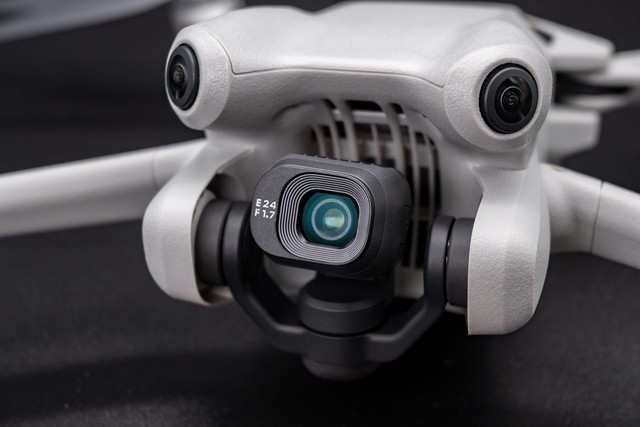
The camera is the reason the Mini 4 Pro remains relevant in 2026.
It uses a 1/1.3-inch CMOS sensor with 48MP effective pixels and a 24mm-equivalent f/1.7 lens.
That combination gives the Mini 4 Pro significantly more photographic flexibility than inexpensive compact drones.
The f/1.7 aperture is especially useful when light levels fall. It allows more light to reach the sensor and helps the drone maintain reasonable shutter speeds and ISO settings in difficult conditions.
48MP Photography
The 48MP mode provides high-resolution files that can be useful when the scene contains plenty of light and fine detail.
However, megapixel count should not be confused with overall image quality.
The most important advantages of the camera are the sensor size, lens, image processing, RAW capability and exposure control.
RAW Photography
The ability to capture DNG RAW files makes the Mini 4 Pro much more useful to photographers who edit their images seriously.
RAW gives you greater flexibility when recovering highlights, adjusting shadows, correcting white balance and fine-tuning color.
For travel photography, landscapes and architecture, that flexibility is often more important than the headline megapixel number.
Camera Rating: 9.2/10
DJI Mini 4 Pro Low-Light Photography

The Mini 4 Pro performs surprisingly well when daylight begins to disappear.
DJI's Night Shots video mode uses improved image processing and noise reduction to produce cleaner low-light footage.
For still photography, the combination of the f/1.7 lens and 1/1.3-inch sensor gives the Mini 4 Pro useful low-light capability, although it cannot compete with the larger sensors used in the Mini 5 Pro, Air 3S or Mavic 4 Pro.
This is one area where the age of the Mini 4 Pro becomes noticeable.
It is very good for sunset, blue hour and illuminated city scenes, but if nighttime photography is your primary reason for buying a drone, the newer Mini 5 Pro or larger Air 3S is a stronger choice.
For a dedicated analysis of low-light drone photography, see our Best Drones for Night & Low-Light Photography in 2026.
Video Quality
The Mini 4 Pro can record up to 4K/60fps HDR and up to 4K/100fps slow-motion footage.
For creators, this is one of the most important upgrades over earlier Mini models.
The drone also supports 10-bit D-Log M and HLG, providing substantially more flexibility for color grading than a basic 8-bit consumer drone.
4K/60 HDR
4K/60 is the sweet spot for most aerial video. It provides enough resolution for detailed footage while giving you smooth motion during pans, tracking shots and fast-moving scenes.
4K/100 Slow Motion
4K/100fps is particularly useful for action sequences, water, vehicles, sports and cinematic slow-motion footage.
D-Log M
D-Log M is valuable for creators who want to establish a more controlled post-production workflow.
It produces a flatter image that preserves more flexibility for color grading compared with the standard profile.
Video Rating: 9.3/10
True Vertical Shooting
One of the Mini 4 Pro's most practical creator features is its rotating gimbal.
The camera can physically rotate into vertical orientation, allowing you to capture portrait-format content without simply cropping a horizontal frame.
This makes the Mini 4 Pro particularly useful for:
- Instagram Reels
- TikTok
- YouTube Shorts
- Travel content
- Real-estate social content
- Mobile-first photography
For creators who publish primarily to smartphones, this is a major advantage.
Flight Performance

The Mini 4 Pro is easy to fly but should not be mistaken for a toy.
Its controls are precise, hovering is stable and GPS positioning gives the pilot a high level of confidence during normal outdoor operations.
Sport mode raises the maximum horizontal speed to 16m/s under DJI's stated test conditions, while Normal and Cine modes provide progressively more controlled flight characteristics.
Wind Performance
Physics remains physics.
The Mini 4 Pro's lightweight airframe is an advantage when carrying it but a disadvantage when the weather becomes challenging.
A larger drone such as the Air 3S or Mavic 4 Pro has more mass and propulsion authority, making those aircraft better suited to stronger wind.
The Mini 4 Pro is therefore best when portability is more important than maximum weather resistance.
Flight Rating: 9.2/10
Omnidirectional Obstacle Avoidance
Obstacle avoidance is one of the Mini 4 Pro's biggest strengths.
The drone uses an omnidirectional binocular vision system supplemented by a downward 3D infrared sensor.
DJI specifies forward, backward, lateral, upward and downward sensing ranges under defined conditions.
Combined with APAS, the system can automatically brake and navigate around obstacles in supported flight scenarios.
This is particularly valuable for beginners and for creators who fly in environments containing trees, buildings and other structures.
However, obstacle avoidance should never be treated as a guarantee against crashes.
Thin wires, transparent surfaces, small branches and poorly visible objects can still present serious hazards.
Our Best Drones With Obstacle Avoidance in 2026 guide compares the Mini 4 Pro with newer drones using more advanced sensing systems.
Safety Rating: 9.5/10
ActiveTrack 360° and Intelligent Flight Features
The Mini 4 Pro is more than a manually controlled camera platform.
DJI's intelligent flight ecosystem makes it possible to automate many complex shots.
- ActiveTrack 360°
- Waypoint Flight
- MasterShots
- QuickShots
- Hyperlapse
- Panorama
- Cruise Control
- Advanced Return to Home
ActiveTrack 360° is particularly useful for creators who want the drone to maintain focus on a moving subject while following a planned route.
Waypoint Flight is more valuable for photographers and filmmakers who want repeatable camera movements.
Intelligent Features Rating: 9.5/10
DJI O4 Transmission
The Mini 4 Pro uses DJI's O4 digital video transmission system.
DJI specifies a maximum transmission distance of up to 20km under FCC testing conditions and 10km under CE/SRRC/MIC conditions, in unobstructed environments without interference.
Those numbers should not be interpreted as practical or legal flying distances.
Real-world transmission depends on interference, buildings, trees, terrain, regulatory limits and local operating requirements.
The bigger advantage is stability. O4 provides a smooth live feed and strong resistance to interference, making the pilot experience considerably more reassuring.
Transmission Rating: 9.4/10
Battery Life
DJI rates the standard Intelligent Flight Battery for up to 34 minutes of flight time under its stated testing conditions.
Real-world flight time will be lower because pilots rarely fly until the battery is completely depleted.
Wind, temperature, aggressive flight and frequent acceleration also reduce endurance.
The optional Intelligent Flight Battery Plus can extend endurance substantially, but it pushes the aircraft above the 249g threshold and is not sold in Europe according to DJI's current Spanish store information.
For European buyers, this makes the standard battery the more relevant configuration.
Battery Rating: 8.8/10
DJI RC 2 vs RC-N2
The Mini 4 Pro can be purchased with different controller configurations.
The DJI RC-N2 uses your smartphone as the display, while the DJI RC 2 includes its own integrated screen.
For casual users, the RC-N2 can make the initial purchase cheaper.
For frequent pilots, the RC 2 is considerably more convenient because you don't need to mount and connect your phone before every flight.
If the price difference is manageable, we'd choose the RC 2 configuration for a long-term purchase.
DJI Mini 4 Pro for Travel
This is where the Mini 4 Pro makes perhaps the strongest argument for itself in 2026.
Its small size means it can travel almost anywhere without becoming a major piece of luggage.
It is an excellent companion for:
- Mountain trips
- City breaks
- Road trips
- Beach holidays
- Landscape photography
- Travel filmmaking
For more practical advice on transporting and flying drones internationally, see our Drone Travel Guide 2026.
DJI Mini 4 Pro for Beginners
The Mini 4 Pro is one of the easiest serious camera drones to recommend to a beginner.
The combination of GPS positioning, omnidirectional obstacle sensing, automatic return-to-home, intelligent flight modes and a compact design significantly reduces the initial learning curve.
However, beginners should still learn manual flight fundamentals.
Obstacle avoidance is an assistance system, not a substitute for situational awareness.
New pilots should also understand local registration, airspace and privacy rules before flying.
Our Drone Laws & Safety Guide is a useful starting point.
DJI Mini 4 Pro vs DJI Mini 5 Pro
This is the most important comparison for anyone considering the Mini 4 Pro in 2026.
| Feature | DJI Mini 4 Pro | DJI Mini 5 Pro |
|---|---|---|
| Weight Class | Under 249g | 249g-class |
| Main Sensor | 1/1.3-inch | 1-inch |
| Photo Resolution | 48MP | 50MP |
| Main Aperture | f/1.7 | f/1.8 |
| 4K Video | 4K/60 HDR | 4K/60 HDR |
| Slow Motion | 4K/100 | 4K/120 |
| Obstacle Sensing | Omnidirectional | Advanced omnidirectional sensing + LiDAR |
| Best Advantage | Lower price | Better imaging |
The Mini 5 Pro wins on camera technology.
The Mini 4 Pro wins when the price difference becomes large enough.
If the Mini 4 Pro is heavily discounted, buying the older model can make excellent financial sense.
DJI Mini 4 Pro vs DJI Air 3S
The Air 3S is the better choice when camera flexibility, wind performance and longer flight endurance matter more than portability.
The Mini 4 Pro wins on:
- Portability
- Weight
- Travel convenience
- Vertical shooting
- Lower carrying burden
The Air 3S wins on:
- Larger main sensor
- Dual-camera flexibility
- Longer standard flight time
- Stronger performance in wind
- Telephoto shooting
For serious production work, we'd choose the Air 3S.
For travel and everyday photography, the Mini 4 Pro remains extremely compelling.
DJI Mini 4 Pro vs DJI Flip
The DJI Flip approaches the compact-drone market differently.
It emphasizes creator convenience and integrated propeller protection, while the Mini 4 Pro offers more advanced obstacle sensing, a more traditional premium camera-drone design and a broader set of advanced flight capabilities.
If you want the easiest possible self-filming experience, the Flip deserves consideration.
If you want a more complete compact aerial photography platform, the Mini 4 Pro is the stronger choice.
Real-World Strengths
1. Exceptional Portability
The Mini 4 Pro is small enough to become part of your everyday travel kit.
2. Excellent Camera
The 1/1.3-inch sensor and f/1.7 lens continue to produce impressive results.
3. True Vertical Shooting
The rotating gimbal is extremely useful for modern social-media workflows.
4. Strong Safety System
Omnidirectional sensing is a major advantage over older Mini models.
5. Professional Recording Options
RAW, D-Log M, HLG and 4K/100 provide substantial creative flexibility.
6. Mature DJI Ecosystem
Accessories, software, intelligent flight features and controller options make the Mini 4 Pro a mature platform.
What We Don't Like
1. The Mini 5 Pro Has a Better Camera
This is the biggest problem for the Mini 4 Pro in 2026.
2. Small Airframe in Strong Wind
Its portability comes at the expense of some stability compared with heavier drones.
3. No Telephoto Camera
Unlike the Air 3S and Mavic 4 Pro, the Mini 4 Pro has a single main camera.
4. Battery Plus Has Regulatory Implications
The larger battery changes the aircraft's weight classification and isn't sold in Europe.
5. Price Determines Its Value
At the wrong price, the newer Mini 5 Pro is simply more attractive.
Who Should Buy the DJI Mini 4 Pro in 2026?
The Mini 4 Pro makes the most sense for:
- Travel photographers
- Beginners wanting a serious camera drone
- Social-media creators
- Hikers and outdoor photographers
- Real-estate creators working with compact equipment
- Anyone who prioritizes portability
- Buyers finding a significant discount
Who Should Skip It?
You should consider the Mini 5 Pro instead if:
- Low-light image quality is a major priority
- You want a 1-inch sensor
- You want the newest Mini-series technology
- The price difference is relatively small
You should consider the Air 3S if:
- You want a second camera
- You regularly fly in stronger wind
- You need longer standard flight endurance
- You shoot professional commercial work
DJI Mini 4 Pro Price in 2026
DJI's Spanish store currently lists the Mini 4 Pro from €679 with the RC-N2 controller. The DJI RC 2 configuration is listed at €849, while the Fly More Combo with DJI RC 2 is listed at €959. Availability and pricing can change, so buyers should check the current price before purchasing.
Check the DJI Mini 4 Pro with DJI RC 2 on Amazon
At €679, the Mini 4 Pro remains competitive, but discounts can make the value proposition considerably stronger.
Our buying rule is simple:
If the Mini 4 Pro is substantially cheaper than the Mini 5 Pro, buy the Mini 4 Pro. If the prices are close, choose the Mini 5 Pro.
MidronePro Scorecard
| Category | Score |
|---|---|
| Design | 9.8/10 |
| Portability | 9.9/10 |
| Camera | 9.2/10 |
| Video | 9.3/10 |
| Flight Performance | 9.2/10 |
| Obstacle Avoidance | 9.5/10 |
| Tracking | 9.5/10 |
| Battery | 8.8/10 |
| Travel | 9.9/10 |
| Value | 9.0/10 |
| Overall MidronePro Rating | 9.3/10 |
Final Verdict: Is the DJI Mini 4 Pro Still Worth Buying in 2026?
Yes — but the price matters more than ever.
The DJI Mini 4 Pro has aged remarkably well.
Its camera remains excellent, its video capabilities are still strong, its obstacle avoidance is far better than that of earlier Mini generations, and its tiny form factor remains one of its biggest competitive advantages.
The arrival of the Mini 5 Pro does not make the Mini 4 Pro obsolete.
Instead, it changes its position.
The Mini 4 Pro is now the smart-value compact camera drone for buyers who want much of the premium Mini experience without paying for the latest generation.
For travel, beginners, social-media creators and everyday aerial photography, it remains an easy recommendation when discounted.
But if you want the best compact camera available and the price difference is relatively small, the Mini 5 Pro is the better long-term purchase.
MidronePro Rating: 9.3/10
Our recommendation: Buy it at the right price.
Learn More at MidronePro Academy
Want to learn more before choosing your next drone? Explore these related MidronePro guides and reviews:
- How to Choose the Right Aerial Drone in 2026 — Learn how to choose the right drone based on camera quality, portability, flight performance, obstacle avoidance and your flying goals.
- Best FPV Drones for Beginners 2026 — Explore beginner-friendly FPV drones and understand how they differ from conventional camera drones.
- Best Drones Under $500 in 2026 — Compare capable drones for buyers who want strong features without moving into premium pricing.
- How to Fly a Drone: Complete Beginner's Guide — Learn essential flight techniques, battery management, wind handling and safe flying practices.
- DJI Neo 2 Review 2026 — See how DJI's newer autonomous camera drone compares with traditional camera drones such as the Mini 4 Pro.
- Best Drones Under 250g in 2026 — Compare the Mini 4 Pro with other lightweight camera drones designed for maximum portability.
Frequently Asked Questions
Is the DJI Mini 4 Pro still worth buying in 2026?
Yes. The Mini 4 Pro remains an excellent compact camera drone in 2026, especially when it is substantially cheaper than the Mini 5 Pro. It still offers a 48MP camera, RAW photography, 4K/60 HDR, 10-bit D-Log M, vertical shooting and omnidirectional obstacle sensing.
Is the DJI Mini 5 Pro better than the Mini 4 Pro?
For image quality and newer technology, yes. The Mini 5 Pro uses a larger 1-inch sensor and offers newer imaging capabilities. However, the Mini 4 Pro can be the better value if its price is significantly lower.
Does the DJI Mini 4 Pro have obstacle avoidance?
Yes. The Mini 4 Pro uses an omnidirectional binocular vision system supplemented by a downward 3D infrared sensor. DJI specifies sensing in forward, backward, lateral, upward and downward directions under defined conditions.
Does the DJI Mini 4 Pro shoot RAW photos?
Yes. The Mini 4 Pro supports DNG RAW photography in addition to JPEG capture.
Can the DJI Mini 4 Pro shoot vertically?
Yes. Its three-axis gimbal can rotate for True Vertical Shooting, making it particularly useful for TikTok, Instagram Reels, YouTube Shorts and other portrait-oriented content.
Can the DJI Mini 4 Pro shoot 4K video?
Yes. It can record 4K/60 HDR video and up to 4K/100fps slow-motion footage under supported recording settings.
Does the DJI Mini 4 Pro support D-Log M?
Yes. The Mini 4 Pro supports 10-bit D-Log M and HLG recording for creators who want greater flexibility during post-production.
How long does the DJI Mini 4 Pro battery last?
DJI rates the standard Intelligent Flight Battery for up to 34 minutes under its stated testing conditions. Actual usable flight time is normally lower because pilots should maintain a reserve for safe landing and return.
Is the DJI Mini 4 Pro good for travel?
Yes. Its sub-249g standard configuration, foldable design and compact dimensions make it one of the easiest serious camera drones to travel with.
Is the DJI Mini 4 Pro good for beginners?
Yes. GPS positioning, omnidirectional obstacle sensing, automatic return-to-home and intelligent flight features make it approachable for beginners. New pilots should still learn manual flying skills and local drone regulations.
Is the DJI Mini 4 Pro good for night photography?
It is capable of good low-light photography for its class, thanks to its 1/1.3-inch sensor and f/1.7 lens. However, the newer Mini 5 Pro and larger Air 3S offer stronger low-light potential because of their newer or larger imaging systems.
What is the DJI Mini 4 Pro's biggest advantage?
Its biggest advantage is the combination of portability and capability. Very few drones this compact combine a high-quality camera, RAW capture, 4K HDR video, vertical shooting, intelligent flight features and omnidirectional obstacle sensing.
What is the biggest disadvantage of the DJI Mini 4 Pro?
The biggest disadvantage in 2026 is that the newer Mini 5 Pro offers a larger 1-inch sensor and newer technology. This makes the Mini 4 Pro's value highly dependent on its purchase price.
Should I buy the DJI Mini 4 Pro or DJI Mini 5 Pro?
Buy the Mini 4 Pro if you find a significant discount and mainly need portability, excellent image quality and reliable safety features. Choose the Mini 5 Pro if the price difference is relatively small or if image quality and low-light performance are your priorities.


